A four-dimensional building-block puzzle in VR, for Meta Quest.
Found a bug or have a suggestion? Open an issue on GitHub (free account required). Please include the version shown on the game's About page.
Stereoscopic videos & photos — real 3D in a VR headset (Meta Quest), flat 2D preview everywhere else.
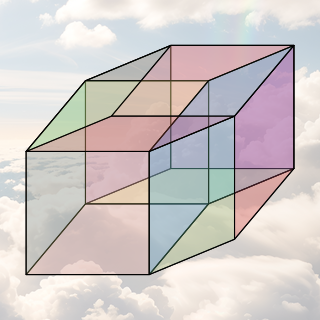
Think of the Soma cube: a few pieces made of small cubes that assemble into a larger shape. Tesserian is that, one dimension up. The pieces are built from tesseracts — four-dimensional cubes — and you move and turn them in genuine four-dimensional space until they fit the goal shape. You look at that space from inside a VR headset: the fourth coordinate is folded into what you see, and after a while you stop translating and simply see it (in the best case 🙂).
Many people wonder why our experienced world has 3 spatial dimensions and how to imagine a world with four. As this is generally quite tough to do mentally, Tesserian does the calculations for you.
Tesserian is actually the successor of 4D Building Blocks (2006), which delivered the third dimension through red/cyan anaglyph glasses or the magic-eye trick at a time when Virtual Reality simply did not exist. VR finally gives the stereo depth for free, with the head doing the looking around — so the whole thing could be rebuilt around that. Tesserian looks nothing like its ancestor, but its 4D geometry descends directly from the old code.
Fair warning: this is not a casual game, and 4D will not click in half an hour if it is new to you. You will probably want to read about it elsewhere (see Further reading below), and there is no shame in watching selected parts of the introduction again or repeating steps of the tutorial. That is normal. The introduction and the tutorial can be started again from the menu at any time, and in the introduction you can skip individual passages with the right thumbstick. The puzzles range from a breeze to really hard. To be honest, I probably could not solve every puzzle in the game myself XD, and I am very curious who will.
The game does not fake its picture. Hidden-surface removal is computed in four dimensions: for every frame the game works out exactly which parts of a piece are hidden behind other pieces in 4D, and only what is visible from your 4D viewpoint is drawn. What reaches your eyes is that visible surface, projected into the three dimensions of your play space and rendered as glass — see-through, so nothing inside a shape is ever lost. Colour and a few further cues encode the fourth coordinate, so depth in the fourth direction reads as naturally as depth in the third.
Solving levels earns points, and points unlock exhibits in the Polychoron Watch: the 47 non-prismatic convex uniform polychora, the four-dimensional counterpart of the 13 Archimedean solids. They rotate in front of you, giving an almost meditative experience. The tesseract and the 24-cell are among them, up to shapes with thousands of cells, unlocked one after another with your (hard-)earned points. Their short names follow the convention of Jonathan Bowers.
Like the picture, the sound is not made up. In its Solid and Hollow modes the Watch's ambience is tuned to the eigenfrequencies of the polychoron in front of you — the frequencies at which it would vibrate as a physical body. They come from a genuine modal analysis of each of the 47 as an elastic four-dimensional body: once solid, once hollow, its cells thin 3D walls welded together and bending into the fourth direction.
I have fond memories of the Higher Dimensions forum, where people build 4D things for the joy of it. Special thanks to quickfur for one of the best visualization guides and endlessly patient explanations, especially on the uniform polychora, which are the rewards in Tesserian.